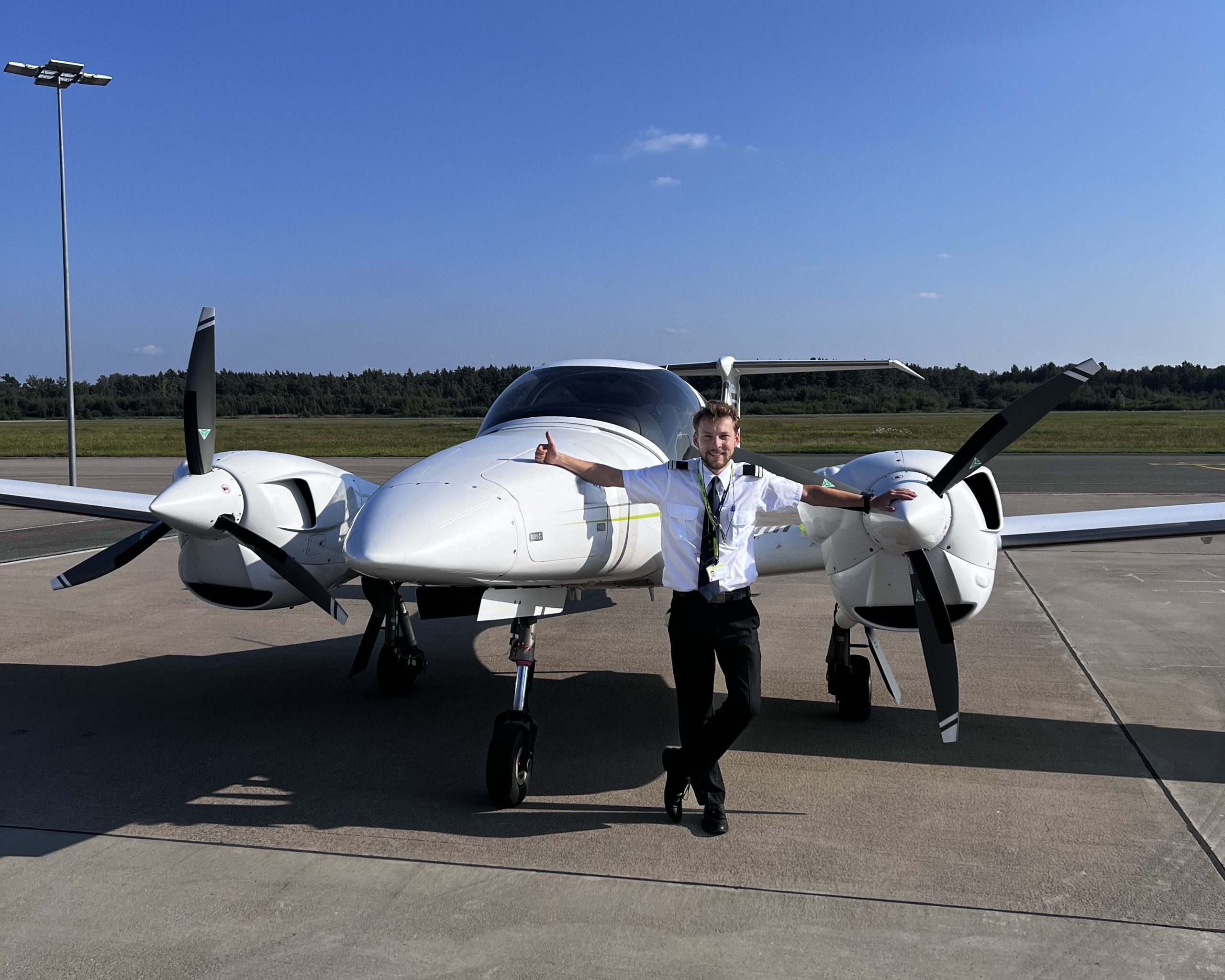
airBaltic Pilot Academy not only attracts aspiring pilots from across the Baltics, but also creates opportunities for them to build their careers closer to home. With operational bases in Riga, Tallinn, and Vilnius, graduates can return to their home countries while flying for one of Europe’s most modern airlines. For many students, this combination of international-level training and the possibility to stay connected to family and home is one of the Academy’s biggest advantages.
One of those graduates is Kazimieras Starkevičius, a Lithuanian pilot who joined airBaltic Pilot Academy in autumn 2022 and today flies the Airbus A220 from the airline’s Vilnius base.
Choosing the Pilot Academy
After completing his university studies, Kazimieras began searching for opportunities to obtain a pilot’s license. However, the timing was challenging. The aviation industry was only beginning to recover after the pandemic, and airline-supported cadet programs were still limited.
“Since this was the post-pandemic period and the aviation industry was just beginning to recover, there were very limited airline-funded cadet programs available,” he explains.
For a Lithuanian candidate, the Academy’s location in neighboring Latvia immediately stood out as a practical and accessible option. Still, the deciding factor was not only geography.
“The key factor was financial support from the airline and the possibility, upon completion of the training, to start working on a jet airliner.”
Before beginning his pilot training, Kazimieras had already gained experience in aviation, working in the technical department of a Lithuanian ACMI company. That experience motivated him to pursue the dream he had carried since childhood.
Intensive Training and Long Days
Looking back at his studies, Kazimieras describes the theoretical phase as demanding mainly because of its pace and intensity.
“I would say that the theoretical part itself is not particularly difficult to understand. For me, the real challenge was the intensity of the studies and the pace at which the material had to be covered.”
During this phase, returning home to Lithuania was nearly impossible because of the demanding schedule. The practical flying phase later brought more flexibility and a different perspective on the training.
“The practical flying phase that followed the theoretical training really helped me understand what all the effort in the classroom was for.”
As flight training progressed, he was able to travel home more often and reconnect with family and friends in Lithuania.
Returning Home to Fly
After graduating in autumn 2024, Kazimieras began his Airbus A220 type rating and completed his first passenger flight by the end of the year. Soon after line training, he started flying from airBaltic’s Vilnius base.
“It was perfect timing,” he says. “After graduation and line training I was able to start working in Vilnius base, which is just an hour drive from my hometown Kaunas.”
For him, the possibility to be based closer to home has made a significant difference.
“This allows me to spend much more time with relatives and friends. Especially during the intense flying in summertime, I can use my days off helping out at the family farm.”
Today, Kazimieras has accumulated around 800 flight hours on the Airbus A220. While he modestly describes it as “not much yet,” he sees it as a strong beginning to his aviation career.
Flying Above the Alps
Although every route brings something different, some flights stand out more than others.
“I don’t have one specific route,” he says, “but if I had to choose, I particularly enjoy flights that take us over the Alps.”
Outside aviation, Kazimieras enjoys spending time in nature and especially in the mountains, which makes certain routes particularly memorable.
“During the summer season, Vilnius–Nice is a great example. It combines beautiful mountain scenery with a technically interesting approach.”
Lithuanian Voices in the Cockpit
Flying from Vilnius also means regularly sharing the cockpit with fellow Lithuanian pilots.
“I get to fly with Lithuanian captains a lot, especially when I fly from Vilnius,” he says.
Another special moment comes when operating one of airBaltic’s aircraft painted in the Lithuanian national livery.
“Since the fleet is big, it is a rare occasion to fly the Lithuanian livery aircraft,” Kazimieras explains. “However, not many pilots get such a unique opportunity to show off around airports with their country’s flag aircraft.”
He adds that the aircraft also attracts attention from aviation enthusiasts and plane spotters across Europe.
Building Careers Across the Baltics
Kazimieras’ journey reflects how airBaltic Pilot Academy has become more than just a training center. By attracting talent from across the Baltics and offering career opportunities in different operational bases, the Academy allows young pilots to pursue international aviation careers while staying connected to home.
From studying in Riga to flying passengers from Vilnius, his story shows how aviation can open doors not only to the skies, but also back to the places that matter most.